
MGF for Dogs
Mechano growth factor (IGF-1Ec)
The short answer
MGF is among the least-studied compounds on this site in any species, and there is no canine clinical data at all — the evidence is mechanistic. Its very short half-life means systemic exposure is limited, which is reassuring, but it shares the IGF-1 family contraindication: it should not be used in a dog with known or suspected cancer, and it should not be stacked with IGF-1 LR3.
What it is and how it is thought to work
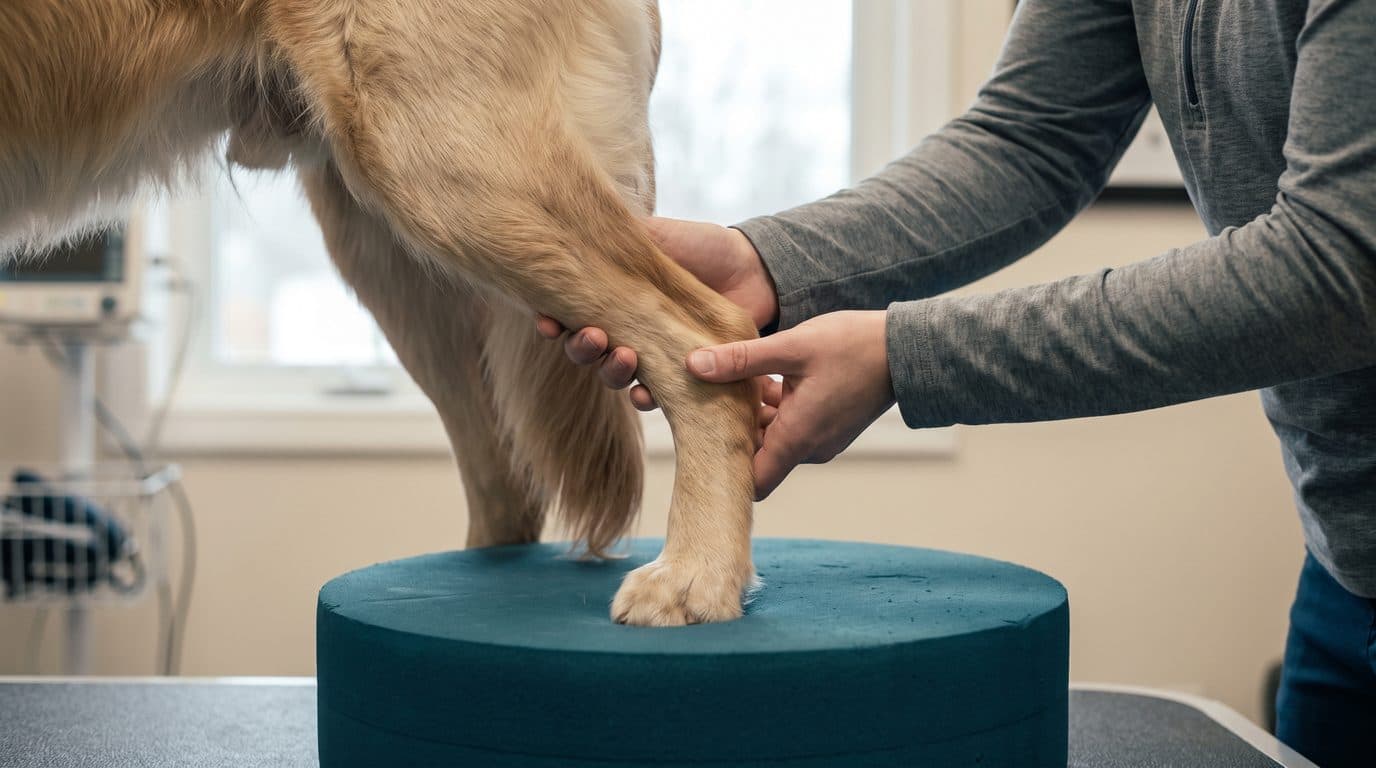
MGF is a splice variant of the IGF-1 gene that muscle produces in response to mechanical loading and damage. Its half-life is extremely short — around fifteen minutes — which means it acts where it is placed. That is why protocols call for injecting close to the injured muscle rather than anywhere convenient.
Mechanism in clinical terms
The IGF-1Ec splice variant, expressed in response to mechanical stimulus. Reported to activate satellite cells and initiate myoblast proliferation and differentiation. Half-life around 15 minutes confines activity to the injection region, making proximity to the target tissue a protocol requirement rather than a preference.
Canine dosing by weight class
Figures below are reported as they appear in the source literature. They are not recommendations, and dosing for an individual dog must be set by a veterinarian.
Small / toy breed
under 22 lb (10 kg)
- Reported dose
- 4–50 mcg per day
- Frequency
- Daily or every other day
- Duration
- 4-6 weeks
- Studied for
- Localised muscle repair, post-injury recovery
Medium breed
22–77 lb (10–35 kg)
- Reported dose
- 20–175 mcg per day
- Frequency
- Daily or every other day
- Duration
- 4-6 weeks
- Studied for
- Muscle repair, post-injury recovery
Large / giant breed
over 77 lb (35 kg)
- Reported dose
- 70–300 mcg per day
- Frequency
- Daily or every other day
- Duration
- 4-6 weeks
- Studied for
- Muscle repair, muscle loss, post-injury recovery
Need a figure for a specific weight? Use the dose calculator, or see the weight-specific pages: small / toy breed, medium breed, large / giant breed.
Contraindications and warnings
Read these before anything else on the page.
⚠ Contraindicated with active cancer
As an IGF-1 family growth factor, MGF promotes cell proliferation. It should not be used in a dog with known or suspected malignancy.
Do not stack with IGF-1 LR3
Both act on IGF-1 receptor pathways. Running them together stacks the same signal without added benefit and complicates attributing any adverse effect.
Example research protocol
A representative timeline drawn from the published literature, showing what is monitored and when. Any actual protocol should be set by the veterinarian managing the case.
- 1Week 1Localised initiation
What owners observe
The injection must go as close to the injured muscle as is practical. Mild soreness at the site is normal. Activity should be restricted during treatment — this is a repair protocol, not a performance one.
Clinical monitoring
2-5 mcg/kg/day intramuscularly near the target muscle. Aspirate before injecting. The short half-life makes proximity to the injury the single most important variable.
- 2Weeks 2-4Active regeneration
What owners observe
Improved limb use and weight bearing, with reduced pain behaviour. Controlled lead walks are appropriate; off-lead and high-impact activity are not.
Clinical monitoring
Satellite cell proliferation and myoblast differentiation expected. Sometimes combined with subcutaneous BPC-157 for complementary tissue repair. Assess muscle mass and symmetry at week 3.
- 3Weeks 4-6Taper and rehabilitate
What owners observe
Near-normal muscle function with a graduated return to activity. Structured physiotherapy during this phase does more for the outcome than extending the protocol would.
Clinical monitoring
Reduce to every other day for the final two weeks then discontinue. Muscle protein synthesis should sustain gains after cessation. Reassess at week 8.
What MGF is investigated for
Muscle wasting
Loss of muscle mass from age, disuse, chronic illness, or prolonged rest after injury.
Tendon and ligament injury
Strains, partial tears, and chronic tendinopathies in working, sporting, and active dogs.
Post-surgical recovery
Supporting tissue repair, comfort, and return to function after an orthopaedic or soft tissue procedure.
How it compares
- IGF-1 LR3 vs MGF for dogs — how MGF differs from IGF-1 LR3
Common questions
Is MGF safe for dogs?+
MGF is among the least-studied compounds on this site in any species, and there is no canine clinical data at all — the evidence is mechanistic. Its very short half-life means systemic exposure is limited, which is reassuring, but it shares the IGF-1 family contraindication: it should not be used in a dog with known or suspected cancer, and it should not be stacked with IGF-1 LR3.
How much MGF should I give my dog?+
Reported doses vary by weight class. Small / toy breed (under 22 lb (10 kg)): 4–50 mcg per day, daily or every other day. Medium breed (22–77 lb (10–35 kg)): 20–175 mcg per day, daily or every other day. Large / giant breed (over 77 lb (35 kg)): 70–300 mcg per day, daily or every other day. These figures are reported as they appear in the source literature and are not recommendations — dosing for an individual dog must be set by a veterinarian who has examined the animal.
How is MGF given to dogs?+
MGF is administered by intramuscular injection. See the injection guide and reconstitution guide for handling detail.
What is the evidence for MGF in dogs?+
MGF is graded as preliminary evidence on this site, drawing on 2 cited studies. MGF is a splice variant of the IGF-1 gene that muscle produces in response to mechanical loading and damage. Its half-life is extremely short — around fifteen minutes — which means it acts where it is placed. That is why protocols call for injecting close to the injured muscle rather than anywhere convenient.
References
- 1.Goldspink G Mechanical signals, IGF-I gene splicing, and muscle adaptation. Physiology, 2005. PMID 16024511
- 2.Kandalla PK, Goldspink G, Butler-Browne G, Mouly V Mechano Growth Factor E peptide (MGF-E), derived from an isoform of IGF-1, activates human muscle progenitor cells and induces an increase in their fusion potential at different ages. Mechanisms of Ageing and Development, 2011. PMID 21354439
Educational information — not veterinary medical advice
Everything on this page is compiled from published peer-reviewed literature for educational and research purposes. It does not establish a veterinarian-client-patient relationship (VCPR) and is not a substitute for veterinary examination and diagnosis. Most compounds described here are investigational or used off-label and are not FDA-approved for these purposes in dogs. Extralabel drug use in animals requires a valid VCPR and the direct supervision of a licensed veterinarian under AMDUCA (21 U.S.C. §360b). Dosing figures are reported as they appear in the source literature and are not recommendations.